Shopping Cart


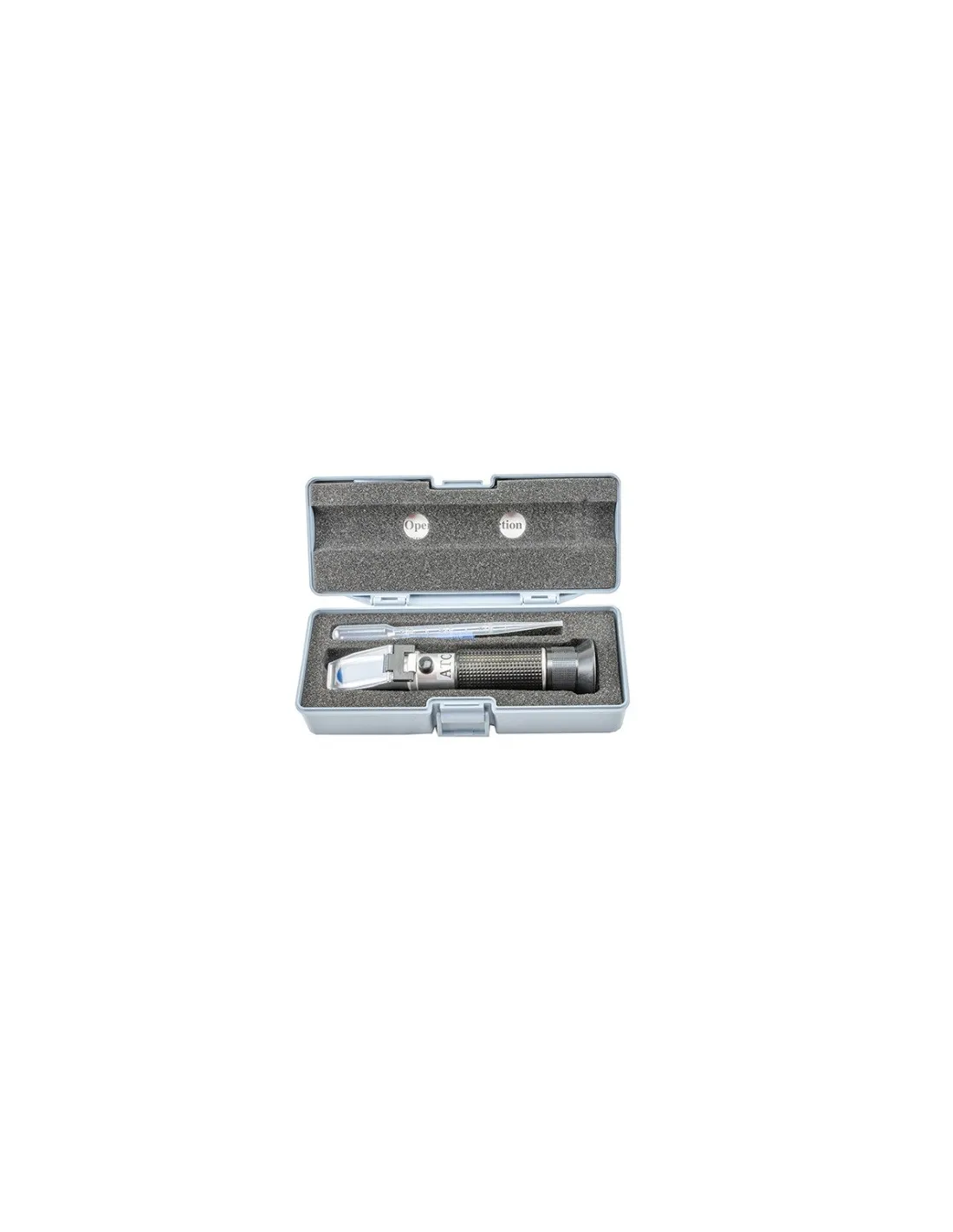
Refractometer
AgriStore di Cosenza V.
Right of withdrawal
You have 14 calendar days to withdraw from your purchase, with no need to give a reason. More information
The Refractometer is an optical measuring instrument, with triple scale reading, with which it is possible to determine the sugar content of the must. The principle of measurement is based on the refraction of light, which depends on the type and concentration of the substances dissolved in the liquid, for example sugar. The refractometer therefore measures the density of liquids: the greater the latter, the higher the refractive index will be. The Refractometer is supplied with a hard case and is calibrated, therefore ready for use and has automatic temperature compensation operating from 10 to 30 ° C, so the data that appears is real and definitive.
The instrument is made of metal, except for the prism cover, and is equipped with an automatic temperature control system (ATC).
How to use the refractometer?
This tool is easy to use. First point the front end towards a bright light and adjust the bezel until you get a clear view. Subsequently, a drop of dioptric oil must fall on the luminous surface, then clean the surface and add a few drops of the liquid to be measured, close the cover plate and press lightly. What will appear is the reading relating to the sugar content of the measured solution (eg wine, honey, juices).
Fields of application:
- in determining the best beet harvesting time;
- in the manufacturing industry for the quality control of the raw materials used and the final product for fruit, honey, beverages and juices;
- in determining the exact collection times in order to improve their production;
- to know the quality of the grapes;
- Features of the refractometer:
- 3 measurement scales (0e, Brix, Babo);
- Consisting of refractometer, suction tube, case and reference block;
- Dimensions: 30x40x161 mm;
- Weight 181 gr.
Stairs detail:
- 0-140 ° 0e;
- 0-26 ° Babo (scale used in the wine industry for the concentration of sugar in grapes);
- 0-32% Brix mass bag ** (scale used for the concentration of sugar in fruit and in mechanical workshops for concentration of oily solutions).
Precision:
- 1 ° 0e;
- 0.2 ° KMW Babo;
- 0.2% Brix mass bag
* The Beaumé (Bé) scale is mainly used in Mediterranean countries and indicates the potential alcohol volume that wine can reach if all sugars were to ferment. A Baumé degree corresponds to about 17-18 grams per liter of must, therefore the wine that would be obtained from a hypothetical must with 10 ° Bé should have an alcoholic degree equal to 10. It is also possible to easily convert this scale into the Babo one. multiplying the result by 1.53.
** The Brix scale is mostly used in Anglo-Saxon countries and expresses (at 20 ° C) the grams of sugar for every 100 grams of sugar solution (1 degree Brix corresponds to about 8 grams of sugar per liter of must).
- Typology
- Measuring instruments
8P-O9WN-JVET
4 Items
0806891484437
No reviews
Tap to zoom
